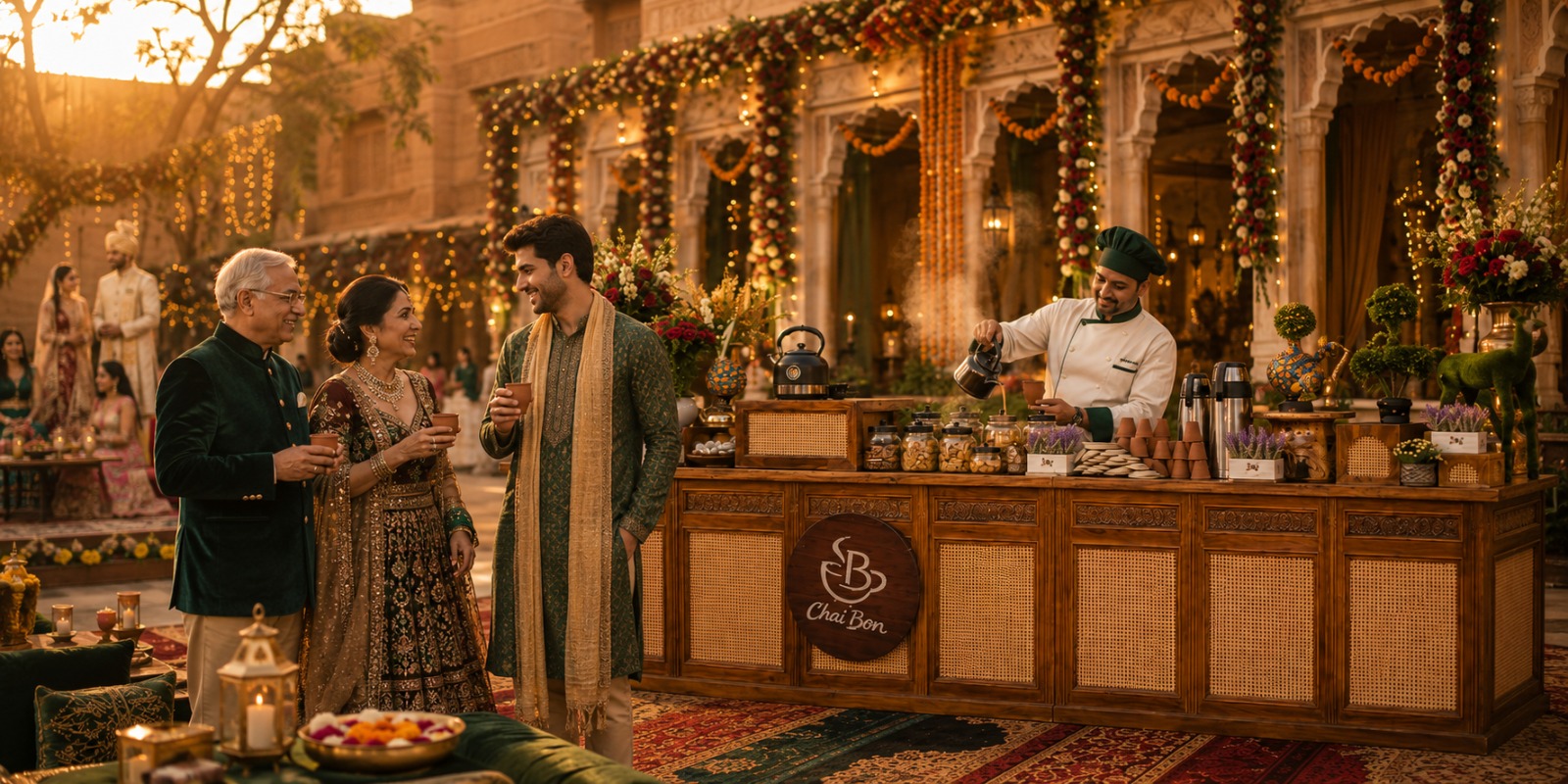
Why Is a Chai Station a Good Addition to a Rajasthan Destination Wedding?
A chai station is a good addition because it does something catering tea cannot: it creates a place. Catering tea arrives on a tray, is consumed, and disappears. A station is a fixed point in the venue that guests walk toward, wait at for a minute, and talk around. That difference — service versus destination — is the entire argument.
Rajasthan sharpens it further. The state holds over 75% of India's heritage properties, and more than 120 of them host weddings, which means the typical Rajasthan celebration spreads across courtyards, lawns, terraces and stepwells rather than a single banquet hall. Guests are constantly in transit between spaces. A station gives that movement an anchor.
What Exactly Is a Wedding Chai Station?
A wedding chai station is a dedicated, styled counter where chai is brewed live in front of guests and served fresh, usually alongside a curated selection of snacks. Unlike a beverage table where pre-made tea sits in urns, a live station has an operator, a visible brewing process, and its own physical design — often a cart, thela or bespoke counter built to match the wedding's décor.
The distinction matters more than it sounds. Chai held in an urn for forty minutes tastes like chai held in an urn for forty minutes. Chai poured from a pan into a clay kulhad in front of you does not.
1. It Turns Guest Arrival Into a Real Welcome
The weakest hour of most destination weddings is the first one. Guests land in Jaipur or Udaipur, drive an hour or more to the venue, and then stand in a lobby waiting for room keys while nothing happens. The wedding has not started for them yet.
A chai station changes the shape of that hour. Instead of waiting, guests are being served. Instead of standing awkwardly, they have something warm in hand and a reason to be somewhere. Hospitality in India has always been expressed through offering rather than announcing, and the first cup a guest is handed sets the tone for everything that follows.
For destination weddings specifically, this matters because arrival is staggered. Guests trickle in across an entire day on different flights and trains. A welcome dinner can only happen once; a chai station can welcome every single guest at whatever hour they walk in.
2. It Solves the Rajasthan Winter Problem Most Couples Underestimate
Rajasthan's wedding season peaks in winter, and Rajasthan's winter is colder than most guests expect.
According to the India Meteorological Department's climatology for Jaipur, January is the coldest month of the year, with a mean minimum temperature of 7.8 °C — and night temperatures that can dip to 2–3 °C. Udaipur's January nights sit around 9–11 °C. Guests flying in from Mumbai, Chennai or Dubai routinely arrive underdressed for this.
Now consider what a Rajasthan wedding actually asks of those guests: a haldi on an open lawn at nine in the morning, a sangeet on a terrace that runs past midnight, a baraat outdoors in December. These are the celebration's best moments, and they are also its coldest.
A live chai station is the most practical answer available. It is not décor at that point — it is the reason guests stay outside long enough to enjoy the function you spent months planning. Cold guests leave early. Warm guests dance.
3. It Offers Familiar Comfort Between Elaborate Meals
Destination wedding menus are ambitious by design — multi-cuisine counters, live grills, elaborate plating across four days and a dozen meals. By day three, guests are not hungry. They are over-fed and quietly craving something simple.
Chai occupies a category of its own here. It is not a meal, it does not compete with the caterer, and almost every Indian guest has a daily relationship with it that no wedding menu can replicate. Offering it well is a form of attentiveness: it signals that you thought about how guests actually feel on day three, not just how the menu photographs on day one.
It also quietly solves inclusion. Elderly relatives who cannot manage a heavy buffet, children who will not eat the canapés, guests who do not drink alcohol at the sangeet — all of them are served by the same counter, without anyone having to make a special request.
4. It Creates the Adda — Where Guests Actually Talk
Every wedding has one spot where people cluster and conversation happens on its own. Planners know that spot is rarely the one on the floor plan.
A chai station reliably becomes it. The reason is structural: brewing takes a moment, so guests wait — and a short shared wait between strangers is one of the most efficient social mechanisms there is. Two families who have never met stand at the same counter, and the ice breaks itself. This is the same dynamic that makes a neighbourhood chai adda work, transplanted into a wedding.
For destination weddings, where two guest lists from different cities are meeting for the first time and are expected to spend four days together, this is not a small benefit. It is one of the few elements that actively mixes your guests rather than just entertaining them.
5. It Works Across Every Function, Not Just One
Most experience additions serve a single moment. A photo booth belongs at the sangeet. A dessert counter belongs at the reception. A chai station is unusual in that it earns its place at nearly every function on the calendar.
Morning haldi: guests arrive early and cold. Mehndi: women sit for two to three hours with their hands occupied, unable to eat but very able to drink. Sangeet: a warm counter running past midnight keeps energy up. Post-pheras: dawn ceremonies end with exhausted guests who need exactly one thing. Vidaai and departure: a final cup before the cars leave.
This is why the cost calculation looks different from most add-ons. You are not buying an element for one evening. You are buying continuous hospitality across the whole celebration.
6. It Is Live Theatre and Genuine Service at the Same Time
Wedding entertainment usually asks guests to watch. Wedding service usually asks them to consume. A live chai station does both at once, which is rarer than it sounds.
There is genuine craft to watch — the pull of the pour, the aroma released when spices hit the pan, the steam in cold air — and there is a real cup at the end of it. Compare that to a decorative installation that guests photograph once and never return to. The station keeps giving guests a reason to come back.
It also photographs exceptionally well without any effort from your photographer. Steam, clay cups, warm light and guests mid-laugh are the kind of candid frames couples end up choosing for their albums, and they happen naturally around a working station.
7. It Gives Guests Something Specific to Remember
Ask anyone about a wedding they attended two years ago and they will not describe the floral arrangements. They remember specific, small, sensory things.
A chai station manufactures exactly that kind of memory, and it can be made more specific with very little effort. Personalised kulhads that guests take home. Chai colour-coded to each function — one shade for the haldi, another for the mehndi. A signature blend named for the couple. These are inexpensive details that guests talk about for years, precisely because they were unexpected.
There is a broader point here. Rajasthan weddings compete on grandeur, and grandeur has a ceiling — every heritage venue is beautiful, every décor budget buys something impressive. Distinctiveness comes from the small, human details that no other wedding had.
Where Should You Place a Chai Station Across a Rajasthan Wedding?
Placement should follow guest behaviour, not the floor plan's empty corners. Below is how a chai station typically maps across a four-day Rajasthan celebration.
Moment | Typical timing | Why a chai station works | Placement note |
Guest arrival | All day, staggered | Guests arrive tired and unhosted | Near the lobby or check-in, visible on entry |
Morning haldi | 8 am – 11 am | Early start, open lawn, cold air | Edge of the lawn, upwind of the ceremony |
Mehndi | Afternoon | Guests seated for hours, hands occupied | Adjacent to the seating, easily reachable |
Afternoon high tea | 4 pm – 6 pm | The natural chai hour | Central, high-footfall |
Sangeet | 8 pm onwards | Non-alcoholic option, keeps energy up | Away from the speakers, near the seating |
Late night | 11 pm onwards | Cold, long night, hungry guests | Between the dance floor and the exit path |
Dawn pheras | 4 am – 7 am | Coldest hour, most exhausted guests | Near the mandap perimeter |
Vidaai / departure | Morning | A final warm send-off | At the porch, where cars are loaded |
Two placement rules worth following. Keep the station on a path guests already walk, not in a destination corner — foot traffic is what makes it work. And keep it out of the immediate ceremony sightline, since a working counter has motion and sound that competes with a ritual.
How Is a Premium Chai Station Different From Ordinary Tea Service?
This is the objection worth answering directly, because "the caterer already does tea" is what kills most chai station bookings.
| Standard catering tea | Premium live chai station |
Preparation | Brewed in bulk in advance, held in urns | Brewed live, in small batches, in front of guests |
Serving vessel | Standard cups or saucers | Kulhad or curated serveware |
Physical presence | A table at the back of the buffet | A designed counter that fits the wedding's décor |
Staffing | Shared with general catering staff | Dedicated, trained operators |
Menu | One or two options | A curated range of blends, infusions and live snacks |
Guest behaviour | Collected in passing | Becomes a gathering point |
Timing | Fixed meal windows | Runs across functions, including late night and dawn |
Memorability | None | High — this is the point |
The honest summary: catering tea is a beverage line item. A chai station is a hospitality experience. If your only goal is that tea exists on the property, catering covers it. If you want guests to remember it, the two are not substitutes.
What Should You Consider Before Booking a Wedding Chai Station?
Everything above is the case for having one. This is how to make sure it actually works on the day.
Guest count and service speed
The failure mode of a chai station is a queue. Ask any vendor how many cups per hour a single counter sustains at full flow, and how many operators they will staff for your guest count. If you are expecting a rush — right after the pheras, or the moment the sangeet ends — you may need a second counter rather than a longer queue.
Venue logistics
Confirm early with the venue: power availability at the intended spot, water access, permission to use open flame, and whether a heritage property has restrictions on equipment placement. Heritage venues in Rajasthan frequently do. Sorting this two months out is a phone call; sorting it on the morning of the haldi is not.
Weather and timing
Rajasthan's winter nights are cold and its afternoons can still be warm. Plan for both. Ask whether the vendor offers cold or iced options for daytime functions, and whether the station has any wind protection for open lawns and terraces — an open flame on an exposed Jaisalmer terrace in December behaves differently than one in a courtyard.
Hygiene and compliance
Any business serving food in India must hold a valid FSSAI registration or licence under the Food Safety and Standards Act, 2006 — catering and event food service included. Ask for it. Also ask about water sourcing, milk storage and cold-chain handling across a multi-day event, and how staff hygiene is managed on site. For a wedding where hundreds of guests are served repeatedly over four days, this is not a formality.
Presentation and theme
A chai station is visible for the entire event, so it should look like it belongs. Ask whether the counter can be styled to your décor — florals, colour palette, signage, branding — and whether presentation can shift between functions rather than staying identical for four days.
Travel and multi-city weddings
Rajasthan weddings often move: a mehndi in Jaipur, the wedding in Udaipur. Confirm that your vendor travels with a full crew, handles their own logistics and setup, and has done that route before. A vendor who has worked your specific venue is meaningfully lower risk than one who has not.
Booking window
Rajasthan's peak wedding months are heavily contested and the best vendors are committed early. Treat a chai station like any other specialist vendor and lock it in as soon as your dates and venue are fixed.
Bringing It Together: Chai Bon
Everything above describes what a chai station should do. Chai Bon is a Jaipur-based premium artisan chai station built specifically for weddings and events, and it is a reasonable place to start if you want to turn this into an actual booking.
The relevant details, plainly:
Live artisan brewing. Chai is brewed fresh in front of guests and served in traditional kulhad, rather than held in urns.
Coverage across the day, not one slot. Chai Bon structures service around six windows — morning tea from 6 am, a brunch table, afternoon high tea, late-night service from 9 pm onward, an all-day snack bar, and the signature wedding station — which maps directly to how a multi-day Rajasthan wedding actually runs.
A curated menu. Alongside the house masala chai sit Royal Kesar tea, premium hand-beaten coffee, ginger and cardamom chai, and honey, jasmine and lemon green infusions, with a live counter serving bun maska, Kolkata toast, live Maggi, and Rajasthani mathri, kachori and khakra.
Destination travel across Rajasthan. Chai Bon travels to Udaipur, Jaipur, Jodhpur, Jaisalmer, Pushkar and Ranthambore with a full crew and end-to-end logistics, with pan-India service on request.
Theme-matched presentation. Cart branding, florals and colour-coded chai can be matched to each ceremony — clients have used one shade for the haldi and another for the mehndi — and personalised kulhads have gone home with guests as keepsakes.
Track record. Based in Jaipur, Chai Bon has served over 100 weddings across Rajasthan and works with a network of 500+ wedding planners.
The brand's own position on this is worth stating in its own terms: they do not describe themselves as serving tea, but as crafting an experience — which is, ultimately, the distinction this entire article rests on.
Frequently Asked Questions
What is a chai station at a wedding?
A chai station is a dedicated, styled counter where chai is brewed live in front of guests and served fresh, usually with a curated snack selection. It differs from standard catering tea in that it has its own physical design, dedicated operators and a visible brewing process, which turns it into a gathering point rather than a service point.
Why should I add a chai station to my wedding when catering already serves tea?
Because they do different jobs. Catering tea is brewed in bulk and served in passing. A chai station is a fixed destination in the venue that guests walk toward, wait at briefly and talk around — and live-brewed chai served in a kulhad simply tastes better than tea held in an urn. If the goal is that tea exists, catering covers it. If the goal is that guests remember it, they are not substitutes.
Is a chai station suitable for a Rajasthan destination wedding?
Yes, and arguably more so than anywhere else in India. Rajasthan weddings run heavily outdoors across courtyards, lawns and terraces, and the peak season falls in winter, when January nights in Jaipur average a minimum of 7.8 °C and can drop to 2–3 °C. A live chai station keeps guests warm and comfortable enough to stay at outdoor functions rather than retreating to their rooms.
Which wedding functions can have a chai station?
Guest arrival, morning haldi, mehndi, afternoon high tea, sangeet, late-night service, dawn pheras and vidaai all suit one. Unlike most experience additions, a chai station is not tied to a single moment — it works across the full calendar of a multi-day wedding.
Is a chai station a good idea for a winter wedding?
It is one of the most practical additions you can make to a winter wedding. Cold guests leave outdoor functions early, and a warm counter is the simplest way to keep them present and comfortable through late-night and early-morning events.
How do I make a wedding chai station feel premium rather than like a stall?
Four things separate the two: live small-batch brewing instead of bulk urns; considered serveware such as kulhad; a counter designed to match your décor rather than a generic table; and trained, well-presented staff dedicated to the station. Personalisation — named kulhads, chai colour-coded to each function, a signature blend — pushes it further.
What should I ask a chai station vendor before booking?
Cups served per hour and staffing for your guest count; power, water and open-flame requirements to clear with your venue; FSSAI registration and hygiene protocols; whether the counter can be styled to your décor; cold options for daytime functions; and, for multi-city weddings, whether they travel with a full crew and have worked your venue before.
Will a Jaipur-based chai station vendor travel to Udaipur or Jaisalmer?
Established vendors do. Chai Bon, for instance, travels across Rajasthan to Udaipur, Jodhpur, Jaisalmer, Pushkar and Ranthambore with a full crew and handles logistics end to end, with pan-India service available on request. Confirm crew travel, setup and prior experience with your specific venue before booking.
How far in advance should I book a wedding chai station?
As soon as your dates and venue are confirmed. Rajasthan's peak wedding months are heavily booked and specialist vendors commit their calendars early.
Does a chai station work for guests who do not drink alcohol?
Yes, and this is an underrated benefit. At functions like the sangeet where the bar dominates, a chai station gives non-drinking guests, elderly relatives and children somewhere of their own to go — without anyone having to make a special request.