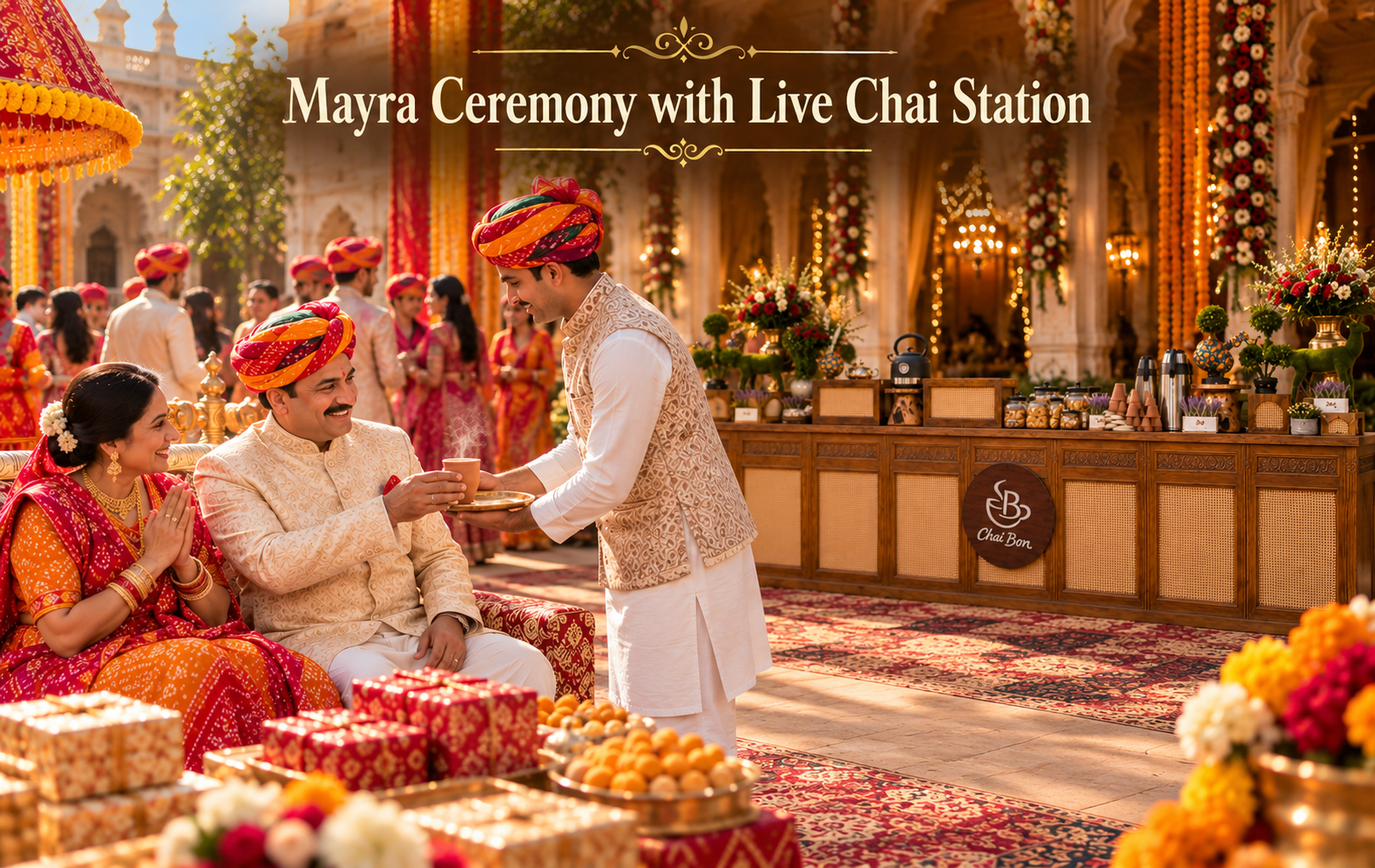
Short answer: The mayra (bhaat) is the emotional Rajasthani ceremony where the maternal uncle arrives with gifts for his sister's family. Because it is built on hospitality — welcoming the mama's procession, hosting a grand lunch, and hours of family storytelling — a live kulhad chai station from Chai Bon is its perfect companion: chai for the welcome, chai after the meal, chai with every story.
In Rajasthan, hospitality has always begun with a single question: "Chai?"
Now picture the mayra. The mama's procession arrives at the gate with trays of gifts, singing mayra geet. The sister welcomes her brother with tears in her eyes. Relatives pour in — grandparents, aunts, cousins — and settle into a long, warm afternoon of ceremony, a grand lunch, and hours of stories that only families can tell.
At a function whose entire soul is hospitality, what could be more fitting than the most hospitable drink in India, served the way it deserves — hot, in a kulhad, from a beautifully styled live station?
The mayra, or bhaat, is one of the most emotional functions of a Marwari or Rajasthani wedding, and yet its refreshments are usually an afterthought. In this guide, we look at why a live chai station belongs at the mayra, what a Chai Bon menu for the function looks like, and how to plan it whether the ceremony happens at home or at a venue.
What is the mayra (bhaat) ceremony in a Rajasthani wedding?
The mayra — known as bhaat in many Marwari, Rajasthani and Haryanvi families — is the pre-wedding ceremony where the maternal uncle (mama) of the bride or groom arrives with gifts for his sister and her family: clothes, jewellery, sweets and shagun.
What makes it special:
- It is the most emotional function of the wedding. The ceremony celebrates the brother-sister bond, and the mama's arrival — often a small procession with traditional mayra geet — routinely leaves the whole courtyard misty-eyed.
- It is family, wall to wall. Grandparents, aunts, uncles, children — the guest list is three generations deep, gathered at home or a modest venue a day or two before the wedding.
- It stretches across an afternoon. The gift ceremony, a grand traditional lunch in the mama's honour, and then the best part: hours of unhurried family conversation.
An emotional welcome, a rich meal, and a long afternoon of stories — every one of those moments has a natural companion, and it is chai.
Why does a live chai station belong at a mayra function?
Three moments in the mayra practically call out for a Chai Bon station:
1. The welcome. In Rajasthani homes, honouring a guest begins with chai — and no guest is honoured at a wedding like the mama at a mayra. Welcoming his procession with steaming kulhads from an elegantly styled station is hospitality made visible: tradition, respect and warmth in a single gesture.
2. After the lunch. A mayra lunch is gloriously heavy — dal baati churma, ghee, sweets. The hour after it is when the family sinks into cushions and conversation, and a round of hot adrak-elaichi chai in clay kulhads is exactly what every single guest, from dada ji to the newly married cousins, is quietly hoping for.
3. The stories. The mayra afternoon is when family history gets retold — the mama's childhood mischief, the sister's wedding twenty-five years ago. A chai station keeps those conversations going, kulhad after kulhad, becoming the gathering point where the best gup-shup of the wedding week happens.
A live station also solves a practical problem: instead of the kitchen running endless chai rounds for a hundred relatives, Chai Bon's team brews and serves continuously, so the hosts actually get to sit with their family.
What should a mayra chai menu include?
A Chai Bon station for a mayra is built around comfort and tradition:
- Kulhad chai — the heart of the menu. Adrak-elaichi chai served steaming in earthen kulhads, exactly the way three generations of the family love it.
- Infusion teas — lighter options for guests who prefer something gentle in the afternoon.
- Bun maska and butter toast — the classic chai companions, perfect for the post-lunch storytelling hour.
- Cookies and rusk — the dippers every dadi reaches for with her kulhad.
- Custom sodas — Chai Bon's chilled option for the younger crowd and for guests who want something cold under the daytime sun.
Everything is served from one styled, elegant station — hot for the elders, cold for the kids, and beautiful in every photograph. Explore the full range on Chai Bon's live station menu.
How do you style a Chai Bon station for a mayra at home or a venue?
The mayra's setting — usually a family home or an intimate venue — is where Chai Bon's heritage styling shines:
- At home: The station fits neatly into a courtyard, terrace or driveway, styled with brass kettles, vintage trays and Rajasthani textiles so it looks like it has always belonged there. Servers carry kulhad rounds to seated elders so no one has to move.
- At a venue: The station is positioned near the family seating, styled to match the mayra's marigold-and-bandhani palette, with the couple's monogram or the family name on display.
- Personal touches: Signage like "Mama ji ki chai" or kulhads served alongside the wedding hashtag turn the station into part of the ceremony's story — details relatives talk about for years.
- Timing the service: One welcome round as the procession arrives, continuous service through the afternoon, and a strong post-lunch round. Planning occasion-wise setups in advance keeps it seamless.
When should you book a chai station for a mayra function?
In the 2026–27 winter season (October to February), wedding dates across Jaipur, Udaipur, Pushkar and Delhi fill quickly — and since mayras happen a day or two before the wedding, they book alongside the main dates.
- 2–3 months before: Reserve your date and take a menu tasting. If you want Chai Bon at multiple functions — mayra, mehendi, sangeet after-party — a multi-function booking locks consistency and is confirmed first in peak season.
- 1 month before: Finalize the menu, styling details and any personalization.
- 1 week before: Confirm the guest count and station placement, whether at home or at the venue.
Destination mayras — at heritage venues in Udaipur or Pushkar — pair beautifully with Chai Bon's destination wedding setups.
A quiet word about who does this well
Chai Bon crafts premium live chai experiences for weddings and family functions — kulhad chai and infusion teas served from elegantly styled stations, alongside bun maska, toast, cookies and custom sodas, with forest green and gold aesthetics that blend seamlessly into heritage settings.
From intimate home mayras in Jaipur to destination celebrations across Udaipur, Pushkar and Pan India, Chai Bon brings the one thing every Rajasthani family function truly runs on: perfectly brewed chai, served with grace. For enquiries, visit chaibon.com or call +91-9057363333.
Frequently Asked Questions
Q1. What is the mayra or bhaat ceremony in a wedding?
The mayra, also called bhaat, is a pre-wedding ceremony in Rajasthani, Marwari and Haryanvi families where the maternal uncle (mama) of the bride or groom arrives with gifts, clothes, sweets and shagun for his sister's family, honouring the brother-sister bond. It is a daytime family function, usually followed by a traditional lunch.
Q2. Is a chai station a good idea for a mayra function?
Yes — a live chai station is ideal for a mayra because the function is built on hospitality: welcoming the mama's procession, hosting a rich traditional lunch, and a long afternoon of family conversation. Kulhad chai serves the welcome, the post-lunch hour and the storytelling equally well, for every generation present.
Q3. What is served at a Chai Bon station at a family function?
A Chai Bon station serves kulhad chai and infusion teas alongside classic companions like bun maska, butter toast, cookies and rusk, plus custom sodas as a chilled option for younger guests. Everything is served from one elegantly styled live station with trained staff.
Q4. Can a chai station be set up at home for a mayra?
Yes — a Chai Bon station fits neatly into a home courtyard, terrace or driveway, styled with brass kettles and Rajasthani textiles to match the setting. Servers also carry kulhad rounds to seated elderly guests, and the team handles the full setup, brewing and service.
Q5. When should you book a chai station for a mayra in the wedding season?
Book 2–3 months in advance for the October–February wedding season, since mayras happen a day or two before the wedding and share the same peak dates. Multi-function bookings covering the mayra, mehendi and sangeet are confirmed first during December and January.